AI coding context tools compared
Most AI tools optimize for relevant snippets. Sourcegraph is built for tasks where your team needs complete, shared, and reproducible codebase answers.
Eight approaches to codebase context
Every AI coding tool needs context about your codebase to be useful. They differ in how they build it, how long they keep it, and how much of the codebase they can reason about at once, from ephemeral per-session agents to persistent, shared code intelligence.
Coding agents
AI code editors
Context engines & AI engineers
Enterprise knowledge search
Platform-native suites
Security analyzers
Open-source & self-hosted search
Codebase understanding infrastructure
Detailed capability comparison
Five dimensions that determine how effective each tool is for engineering tasks at scale. Tools are ordered by breadth of cross-repository code intelligence; security analyzers and single-session agents are strong in narrower, different lanes.
| Tool | Scope & coverage | Search & navigation | Context persistence | Collaboration | Execution & remediation |
|---|---|---|---|---|---|
| Sourcegraph | Spans every org across GitHub, GitLab, Bitbucket, Gerrit, Perforce, Azure DevOps. All branches and revisions. Exhaustive coverage: every instance across all repos. Code Monitors alert on new matches | Structural, semantic, and regex search across every repo, branch, and revision, with exhaustive matching and accurate totals. Go to definition and find all references work across repos out of the box; optional SCIP indexing adds even more precise navigation. Includes commit, diff, and blame history | Persistent, incrementally updated code graph shared by every developer and agent. Independent of any single code host | Single shared infrastructure for all developers and AI agents. MCP server with search, code nav, Deep Search, file browsing, commit/diff search | Batch Changes and Agentic Batch Changes (AI-generated, reviewable) across thousands of repos. Code Insights tracks migration progress over time |
| GitHub platform | Strong within repos hosted on GitHub; Copilot retrieval is aware of the repo. Centered on the platform rather than spanning multiple hosts | Symbol-aware code search with regex, plus Copilot semantic code search (near instant indexing, updated embedding model) and CodeQL for security. But search covers the default branch only, returns a limited ranked set rather than every match with an accurate total, indexes files only up to ~350 KiB, is line oriented (no multi-line or structural search), and offers symbol search in ~10 languages, with no commit diff or commit message search | Persistent platform data; Copilot retrieval depends on indexed GitHub repos | Shared inside GitHub workflows and Copilot; GitHub MCP server available. Less of an independent layer that spans multiple hosts | Copilot coding agents, PR and code review, emerging security autofix within GitHub |
| GitLab (Orbit) | GitLab projects and groups. Orbit indexes SDLC entities plus source code (default branch for source in Orbit Local/Remote) | Exact code search and regex via Zoekt, but scoped to the default branch, limited to files under ~1 MB (filename only beyond a trigram limit) and projects up to ~500k files, and gated to Premium/Ultimate. Orbit knowledge graph adds definitions and references across files, plus merge requests, pipelines, vulnerabilities, and ownership | Persistent native knowledge graph; docs describe index cycles at a point in time for source code. Centered on data hosted on GitLab | Duo agents, API, and MCP inside GitLab. Strongest when standardized on GitLab | Duo agents and lifecycle automation within GitLab |
| Bitbucket (Atlassian) | Bitbucket Cloud and Data Center repositories. AI features accrue through Atlassian Rovo and the wider platform rather than a deep native code-context layer | Repository code search within Bitbucket; the weakest native code intelligence across repos of the major hosts, with no equivalent to precise navigation across repos at scale | Persistent platform data, centered on repos hosted on Bitbucket | Shared inside the Atlassian ecosystem (Jira, Confluence, Rovo), scoped to a single host | Rovo agents and Atlassian automation rather than batch changes across repos |
| Augment Code | Spans multiple repos via the Context Engine (indexed repositories). High recall via semantic search across indexed repos | Semantic search over a structural map of the codebase; dependency and history awareness across repos (vendor claims). Public architecture detail is limited | Persistent context engine, marketed as live and updated on code changes. Local and remote MCP | Shared via remote MCP server | Changes driven by the agent within indexed scope |
| Greptile | Indexes connected repositories into a semantic graph; spans multiple repos. Coverage is scoped to indexed repos and depends on semantic recall rather than exhaustive matching | Semantic codebase Q&A and full-repo context for AI code review, with natural language queries over the graph. Not an exact or regex search product across repos, nor precise go to definition | Persistent semantic index, updated as code changes | Shared via API, a PR review bot, and MCP; oriented around review rather than a general code navigation layer | AI code review, PR comments, and suggested fixes rather than batch changes across the org |
| Factory | Org-context onboarding across repositories for its "Droid" agents; model and interface agnostic (IDE, CLI, Slack, web). Coverage is oriented to what the Droids index | Agent-driven code understanding and retrieval for autonomous tasks rather than an exact or regex search product across repos, or precise go to definition | Persistent org context for its agents; proprietary to the Droid platform | Shared across interfaces (IDE, CLI, Slack, Linear, web); context is consumed by Droids rather than exposed as an open retrieval layer | Autonomous multi-step task execution via Droids |
| Devin / Ask Devin | Indexes individual repos and selected branches; multiple repos can be indexed (query behavior across repos is not documented) | Persistent repo indexing, "advanced code search," Ask Devin cited Q&A, DeepWiki, and MCP access to repository search. Public docs do not detail exact search semantics or a symbol graph | Persistent repo indexing and DeepWiki | Strong native code understanding, coupled to the Devin agent rather than a shared layer independent of any agent | Strong agentic planning, sessions, and execution |
| Amazon Q Developer | AWS-centric. Assistant plus agentic modernization (AWS Transform) over connected repos; coverage across repos is limited outside the AWS ecosystem | Code-aware assistant and modernization agents rather than a general search and navigation product across repos | Persistent within the AWS platform and its indexed scope | Shared through AWS identity and governance; deepest inside AWS workflows | Autonomous refactoring and modernization (mainframe, .NET, VMware) with human review, scoped to AWS |
| Sourcebot | Spans multiple repos across connected code hosts (GitHub, GitLab, Bitbucket, Azure DevOps, Gerrit, Gitea). Open source and self-hosted; coverage is scoped to the repos and branches you index | Fast, symbol-aware code search and navigation (go to definition) via the Zoekt engine, plus an AI "Ask Sourcebot" agent that answers in natural language with inline citations. Focused on search and Q&A rather than exhaustive coverage guarantees across every branch and revision | Persistent self-hosted index, incrementally synced from connected repos | Shared self-hosted instance for a team; MCP server exposes code context to agents (Cursor, Claude Code, and others) | Search and Q&A focused; no built-in batch changes at scale |
| Glean | Enterprise-wide across 100+ connected apps and data sources, including code hosts. Breadth is company-knowledge-first rather than code-precise | Semantic enterprise search and a permission-aware company knowledge graph, with an assistant that answers across sources. Not a precise code navigation product (no go to definition or find all references across repos) | Persistent enterprise index and knowledge graph, updated via connectors | Shared across the org via assistant, APIs, and an agent platform (MCP) | Agents and workflow automation across tools rather than code-specific batch remediation |
| Cursor | Primarily the opened project; team index reuse helps large repos. Coverage depends on embedding recall | Merkle tree sync, syntactic chunking, and embeddings for fast semantic search in the IDE. Limited navigation across repos; no public precise code navigation protocol | Persistent index per user or team; reasoning centered on the session | Index per user or team inside the editor. Supports external MCP servers | Edits across multiple files, plus agents, within a single project |
| Windsurf | Primarily the opened project or workspace; retrieval indexes the local codebase. Coverage depends on embedding recall | Codebase-aware semantic retrieval and agentic edits (Cascade) in the IDE. Limited navigation across repos; no public precise code navigation protocol | Persistent per-user/workspace index; session-centric reasoning | Per-user index inside the editor. Supports external MCP servers | Multi-file edits and agent flows within a single project |
| Security analyzers | Semgrep, Snyk Code, CodeQL. Scanning managed repo by repo or across the org, scoped to security patterns rather than general code intelligence | Detection based on patterns or AI/semantic models, dataflow analysis across files, and reachability. Not a general navigation product across repos | Persistent findings and policies; inspectable, configurable rules (Semgrep, CodeQL) or tunable suppression (Snyk Code) | Shared findings and dashboards; strong governance and audit within the security lane | Strong triage, autofix / Fix PRs, CI blocking, and ticketing for vulnerabilities |
| Coding agents | Single local repository. Best effort coverage depends on what the agent explores | Text and regex (grep, ripgrep). No navigation across repos. Manual git log/diff via shell | None. Rebuilt from scratch on each task | One session, one user at a time | Manual. Single repo per session |
Sourcegraph
GitHub platform
GitLab (Orbit)
Bitbucket (Atlassian)
Augment Code
Greptile
Factory
Devin / Ask Devin
Amazon Q Developer
Sourcebot
Glean
Cursor
Windsurf
Security analyzers
Coding agents
Shared, deterministic code intelligence, no setup required
.svg)
Connect your code hosts and Sourcegraph continuously indexes every repository, branch, tag, and
revision into one searchable corpus. Results are ranked for speed by default, and an exhaustive search (add count:all) returns every match across the entire estate with an accurate total, not
a sample. Nothing to instrument in your build.
Semantic search answers "what looks most relevant?" and returns a ranked list. Sourcegraph answers "what exactly matches, everywhere?" and returns a complete, reproducible result set, the answers that migrations, deprecations, and security response depend on.
Cross-repository code navigation works out of the box, and Deep Search layers agentic, natural-language exploration on top of the same index, all exposed through the Sourcegraph MCP server so every developer and agent queries one shared, permission-aware source of truth.
Optional: compiler-accurate precision with SCIP
For the languages and repositories where you want compiler-grade go-to-definition and find-all-references, Sourcegraph supports precise indexing via SCIP (SCIP Code Intelligence Protocol). It's an upgrade you can adopt per repository, not a prerequisite for search, navigation, Deep Search, or MCP, which all work as soon as your code is connected.
In March 2026, SCIP moved to open governance with a Core Steering Committee including engineers from Uber, Meta, and Sourcegraph, a signal that precise code intelligence is becoming an open standard rather than a proprietary feature tied to a single vendor.
Read the full announcement →The key distinction: relevance vs. coverage
Relevance
Most AI coding tools answer: what code is most relevant to this task? They optimize for relevance, using semantic similarity, embeddings, or agentic exploration to surface the most useful context.
Coverage
Many engineering tasks require a different guarantee: what exists in the system that must not be missed? A migration requires identifying every call site. A security audit requires finding all instances of a vulnerable pattern across every repository.
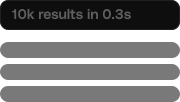
Sourcegraph is the only tool in this comparison that provides exhaustive coverage guarantees, because it indexes every repository, branch, and revision, so an exhaustive search returns every match with an accurate total, not a ranked guess.
How Sourcegraph differs from agents, context engines, platforms, and analyzers
Coding agents
Agents like Claude Code and Codex are powerful at exploring and reasoning about code within a session. But they rebuild their understanding from scratch on every task, and their view is limited to what they happen to search for.
Context engines and AI engineers
Context engines like Augment Code and agentic engineers like Devin improve on this by maintaining a persistent index and, in Devin's case, cited codebase Q&A. This gives agents a better starting context and reduces wasted exploration. But retrieval is still semantic and approximate, and it is optimized for the agent rather than shared across the organization.
Platform suites and security analyzers
GitHub is strong inside GitHub, GitLab Orbit is strong inside GitLab, and Semgrep, Snyk, and CodeQL are strong for security patterns. Each is a credible choice in its lane. But each is anchored to a single code host or a single problem domain (retrieval native to the platform, or coverage of predefined security rules) rather than independent intelligence spanning multiple hosts for arbitrary engineering questions.
Sourcegraph
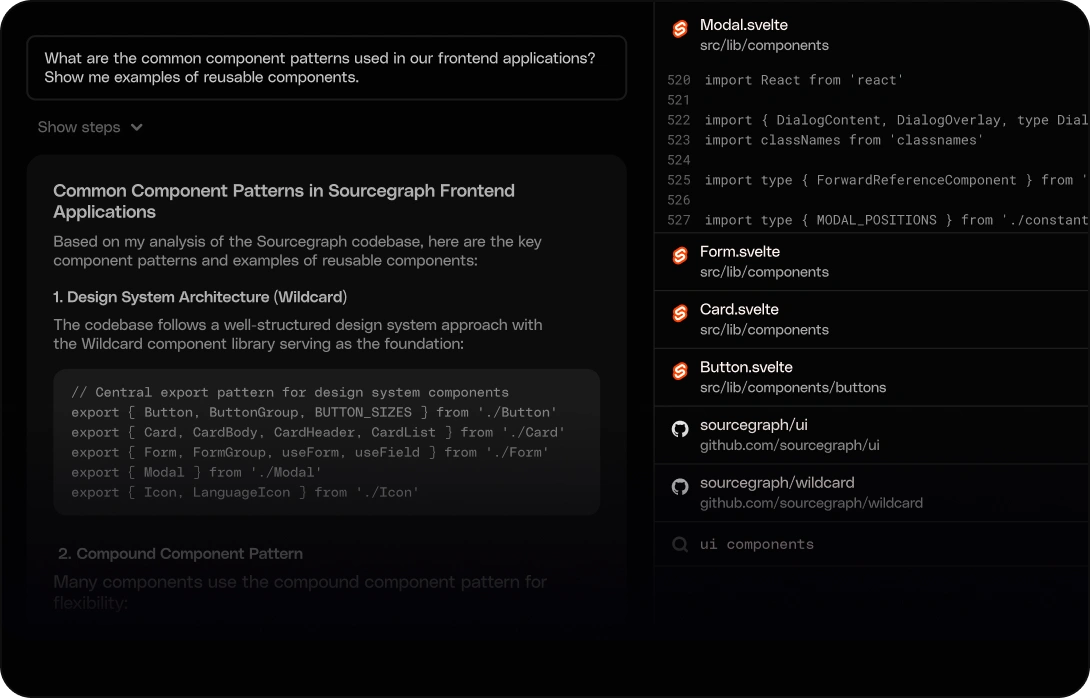
Sourcegraph maintains a continuously updated index of every repository, branch, and revision. Search is ranked and fast by default, and an exhaustive search returns every match across the whole organization with an accurate total, not a ranked guess. Cross-repo code navigation works out of the box. Deep Search extends this further by layering agentic, natural language exploration on top of that index.
Sourcegraph's MCP server exposes this intelligence to any MCP-compatible agent. Agents that previously relied on grep and file exploration can now query a system that already understands how the codebase is organized.
Frequently asked questions

Give your agents the context they need
Connect Sourcegraph to your AI coding tools via MCP and give every developer and agent in your organization the same deterministic, cross-repository code intelligence.